Showing posts with label tansen. Show all posts

Wednesday, August 27, 2025

The Utopian Case of Tudu Hembram


Rethinking Talent Retention: The Utopian Case of Tudu Hembram

In the remote district of Purulia, among the Santhal tribe, I once met a boy named Tudu Hembram. I was introduced to him at Bhalopahar by the late philanthropist Kamal Chakraborty. At that time, he had just finished school and was repairing computers at a local shop. Yet, it was clear his mind was sharper than the hardware he worked on—his interest lay in the abstract beauty of software and mathematics.

Tudu had submitted some of his calculations online, and his ingenuity soon attracted the attention of a Bangalore startup. That is where his story takes an unusual turn, and one that made me reflect deeply.

Unlike most young professionals who chase salaries, savings, and possessions, Tudu followed a different model of existence. He did not draw a salary in the conventional sense. Instead, the company ensured that his family in Purulia was looked after—sending them monthly expenses and arranging medical support whenever needed. His personal requirements—whether food, clothing, or toiletries—were fulfilled through a custom app designed just for him, where he could simply click for his needs. He lived in a modest studio apartment equipped with cutting-edge computers, free from financial anxieties, with his only wealth being his knowledge.

This freedom allowed Tudu to focus entirely on his passion: finding economic ways to use AI. While most engineers are busy advancing AI systems, his goal was to democratize technology, creating simple solutions for small businesses—chatbots for individuals, smart tools for shopkeepers, and even the dream of one day bringing his own village “into the cloud” when satellite internet becomes universally available.

Despite his ascetic lifestyle, Tudu maintained a balance between mind and body, running 10 kilometers each morning to keep fit. His was a life of discipline, simplicity, and purpose.

History reminds us that this is not a new idea. Emperor Akbar maintained his famed Navaratnas—nine jewels of talent—at state expense, among them the legendary Tansen, whose music still echoes through centuries, and Birbal, whose wit and wisdom guided the emperor. Across civilizations, rulers understood that genius blooms only when freed from material burdens.

In ancient Greece, Plato’s Academy and later Aristotle’s Lyceum were supported by patrons who ensured philosophers could devote themselves to thought rather than livelihood. In Renaissance Italy, the Medici family sustained a galaxy of talents—Leonardo da Vinci, Michelangelo, Galileo—by providing them with security, resources, and freedom from financial anxieties. Their patronage birthed some of humanity’s greatest art, science, and philosophy.

The modern world, however, runs on different aspirations. The symbols of success today are big cars, larger houses, and foreign holidays. For a talented individual, the temptation to trade passion for possessions is ever-present. This eternal conflict between the needs of the body and the aspirations of the mind has never disappeared. To resist worldly goods and stick to one’s calling requires unusual inner strength—and equally unusual external support.

What struck me most in Tudu’s case was the company’s unconventional way of retaining him. By removing the burden of salary negotiations, financial planning, and family obligations, they gave him what every true thinker craves—freedom from worry. Many bright minds abandon high-pressure jobs to care for families or escape stress. This model seemed to offer a new path: one where the company assumes responsibility for life’s necessities, while the individual devotes himself fully to creation and problem-solving.

It reminded me of Japan, where young people increasingly choose a solitary lifestyle, avoiding the noise of society, yet deliver extraordinary results in their fields. Tudu’s life felt like an Indian echo of that philosophy: minimalism, focus, and brilliance.

The question that lingers is profound: Could this be the future of work? Instead of higher paychecks and perks, perhaps the real key to nurturing genius is designing ecosystems of trust, care, and freedom.


Afterthought: This story is a utopian thought experiment. No such company exists today—but perhaps it is an idea whose time will come.


Monday, October 31, 2016

Fatehpur Sikri, a creation of Emperor Akbar

Fatehpur Sikri (Hindi: फ़तेहपुर सीकरी, is a city in the Agra District of Uttar Pradesh, India. The city was founded in 1569 by the Mughal Emperor Akbar, and served as the capital of the Mughal Empire from 1571 to 1585, when it was abandoned. After his military victories over Chittor and Ranthambore, Akbar decided to shift his capital from Agra to a new location 23 miles (37 km) west south-west on the Sikri ridge, to honour the Sufi saint Salim Chishti. Here, he commenced the construction of a planned walled city, which took the next fifteen years in planning and construction, with a series of royal palaces, harem, courts, a mosque, private quarters and other utility buildings. He named the city Fatehabad, with Fateh, a word of Arabic origin in Persian, meaning "victorious." It was later called Fatehpur Sikri. It is at Fatehpur Sikri that the legends of Akbar and his famed courtiers, the nine jewels or Navaratnas, were born. Fatehpur Sikri is one of the best preserved examples of Mughal architecture in India.
According to contemporary historians, Akbar took a great interest in the building of Fatehpur Sikri and probably also dictated its architectural style. Seeking to revive the splendours of Persian court ceremony made famous by his ancestor Timur, Akbar planned the complex on Persian principles. But the influences of his adopted land came through in the typically Indian embellishments. The easy availability of sandstone in the neighbouring areas of Fatehpur Sikri also meant that all the buildings here were made of the red stone. The Imperial Palace complex consists of a number of independent pavilions arranged in formal geometry on a piece of level ground, a pattern derived from Arab and central Asian tent encampments. In its entirety, the monuments at Fatehpur Sikri thus reflect the genius of Akbar in assimilating diverse regional architectural influences within a holistic style that was uniquely his own.
The above description is from Wikipedia, after our Taj Mahal visit of 13th October,2016 we proceeded to Fatehpur Sikri next day 14th October by road. a drive of about two and half hours. 
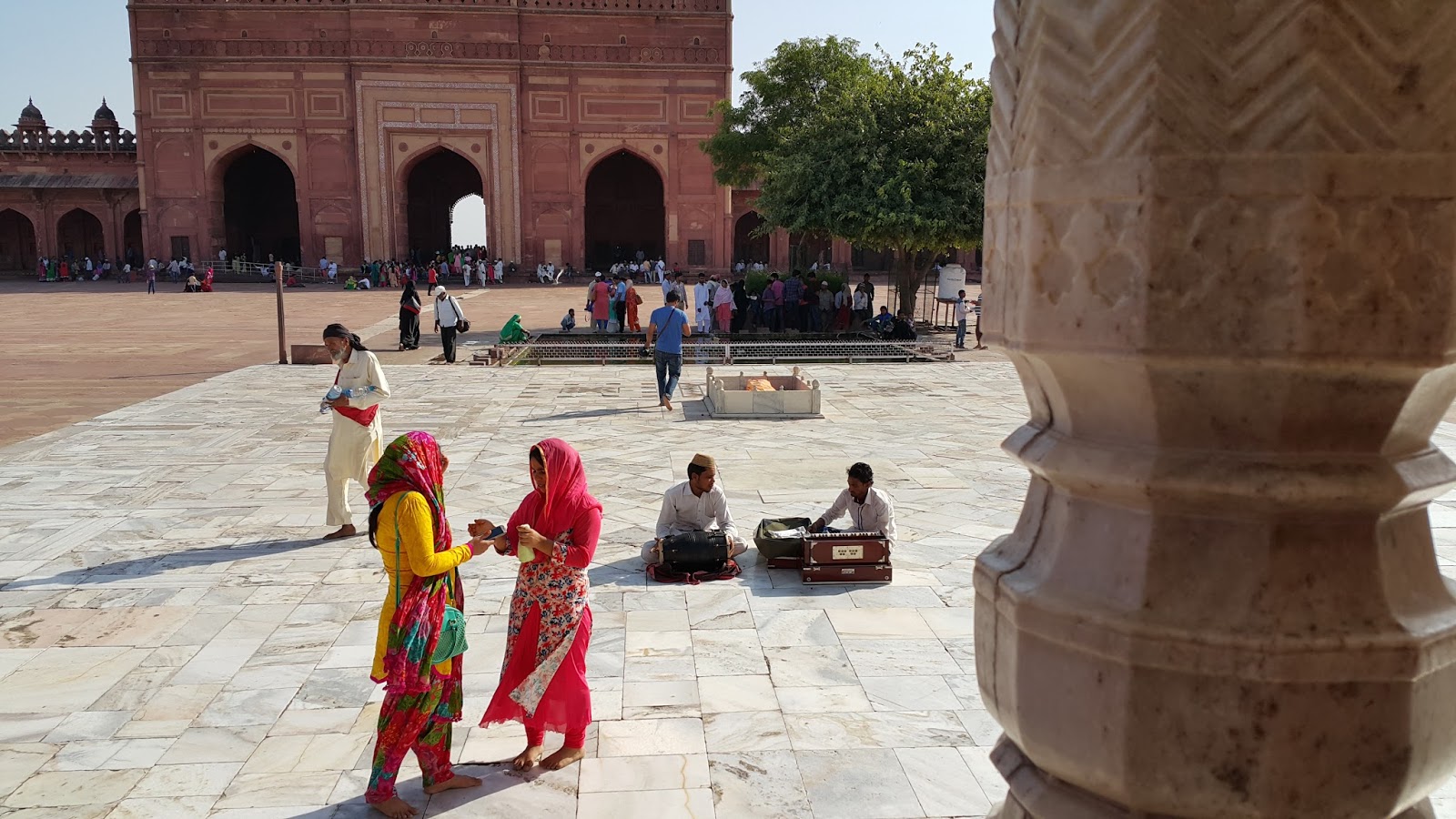
This place has two part visit itinerary, Fatehpur is the walled city with dargah of Salim Chisti, Jama Masjid and Buland Darwaza. One has to go barefooted and we did that in scorching sun.Most of the time we walked in shades. We were duped by a guide in purchasing costly chaddar to spread on the mazhar of Chisit,so advise to visitor to be careful of guides.
Here are the pictures of Fatehpur.
The marble structure of Dargah of Salim Chisti

Omu,Shuvo in lungi because he was in shorts and shorts not allowed inside the dargah,me,Purnima,Bula and Ronny

Courtyard of Chisti Dargah

The Grave of Chisti with our chaddar

Omu tied thread to fulfill his mannat
Me,S N Roy at Dargah of Salim Chisti


Dargah of Salim Chisti
 The Mughal Emperor Akbar came to Chishti's home in Sikri to ask him to pray for a male heir to the throne. Chishti blessed Akbar, and soon the first of three sons was born to him. He named his first son Salim (later emperor Jahangir) in honor of Chishti.[1] A daughter of Sheikh Salim Chishti was the foster mother of Emperor Jahangir. The emperor was deeply attached to his foster mother, as reflected in the Jahangirnama[2] and he was extremely close to her son Qutb-ud-din Khan Koka who was made the governor of Bengal and his descendants are still to be found in Sheikhupur, Badaun.
Akbar held the Sufi in such high regard that he had a great city Fatehpur Sikribuilt around his camp.
This is from Wikipedia.

Meena bazar in Buland Darwaza complex

Buland Darwaza as a backdrop,Shuvo,Ronny,me,Bula,Omu and Purnima

Buland Darwaza from outside

Bula,Omu,Shuvo and Purnima with Buland Darwaza as a backdrop
Buland darwaza and Jama Masjid


 Buland Darwaza (Hindi: बुलंद दरवाज़ा, Urdu: بُلند دروازه‎,[1] pronounced [ˈbʊlənd̪ d̪ərˈʋaːzaː]), or the "Gate of Magnificence", was built in 1576 A.D. by Akbar to commemorate his victory over Gujarat. It is the main entrance to the palace at Fatehpur Sikri, a town which is 43 km from Agra, India.[2][3]
Buland Darwaza is the highest gateway in the world and is an example of Mughal architecture. It displays Akbar's empire.[4][5]
From Wikipedia
................
Sikri is the second part of the visit to the great walled city of 16th century. To enter this place one has to purchase ticket and one needs guide to explain the historical significance.
While walking through this sandstone edifice of thousands of square meters i was trying to imagine that in the late 16th century this place was once treaded by Akbar, his Hindu wife Jodha or Marium, his navaratnas like Birbal, Tansen etc. Yes it is history all around created by the most secular Mughal emperor Akbar who tried to bring a new religion Deen ey Ilahi which was mixture of Hindu and Muslim religion. After coming here one realises that he created most of the Mughal structures visible in India. The Agra red fort is his creation and many other structures of Agra which was the capital of Mughals then were created by him barring for Taj Mahal. A distinct Persian architecture of influence of Indian culture is visible.
Here are some of the pictures of Sikri, It was a scorching hot afternoon and i was thinking that if Tansen would have been there then i would have requested him to sing Raag Megh Mallahar to bring rain, as per the legends he could do that, he could even light fire by singing Raag Deepak.

Kitchen

Panch Mahal at the back ground, Bula,Shuvo and Ronny

Diwane Khaas is visible at a distance
Shuvo and Ronny

Khwabghar

Open courtyard

Foreign tourists clicking away

Diwane aam and the foreign tourists

Diwane aam

Jodhabai's mahal

Aankh micholi tehkhana