Showing posts with label rishikesh. Show all posts

Friday, December 05, 2025

The Magnet of Misery

The Magnet of Misery

In the quiet lane behind the old Hanuman temple in Dehradun lived Baba Samaranand, retired electrical engineer from Bharat Heavy Electricals, self-certified philosopher, and part-time therapist who charged nothing but asked for total surrender to his “methods”. People called him “Baba Magnet-wale” because he had a bowl full of fridge magnets shaped like laughing Buddhas, OM signs, and one suspiciously obscene dancing Shiva that he swore was “pure tantra”.

One monsoon afternoon, a man stormed in wearing a safari suit two sizes too tight, face redder than a Diwali lantern.

“Babaji!” he shouted, “I am Vinod Tandon, branch manager, Punjab National Bank, Sector 17. My life is finished! My BP is 180/110, my wife has stopped cooking paneer, my daughter wants to marry a boy who makes YouTube videos about cryptocurrency, and yesterday the ATM swallowed my own debit card! Tell me, Babaji, is mercury retrograde or have I offended Shani-dev in my previous birth?”

Baba Samaranand was drinking tea from a steel glass that had “Best Employee 1998” printed on it. He looked at Vinod over the rim, slow as a lizard.

“Arre Tandon-sahib, sit. First remove your shoes, they are leaking tension on my floor.”

Vinod sat, sweating.

Baba opened his wooden Godrej cupboard, took out a bright red horseshoe magnet, and placed it in Vinod’s palm.

“Hold this.”

Vinod stared. “That’s it? I came from Chandigarh for a magnet?”

“Shh. Close fist. Feel the pull.”

Vinod closed his fist. “Nothing is pulling.”

“Exactly,” Baba smiled. “That is the whole point. The world is pulling you from all sides, wife, daughter, ATM, cryptocurrency damad. But this magnet is pulling nothing. For ten minutes daily, you sit with it and tell it your problems. It will listen quietly. No advice, no judgement, no forward of good-morning messages. Just listening.”

Vinod looked doubtful. “But Babaji, this is just cognitive behavioural distraction, right?”

Baba’s eyes widened in admiration. “Arre wah! You also read WhatsApp University psychology groups? Good, then you already know it works. Now go, complain to the magnet, not to your liver.”

Vinod left, slightly confused but lighter.

Three weeks later he returned, looking ten kilos thinner and suspiciously cheerful.

“Babaji, miracle! BP is 130/85, wife made paneer twice, daughter’s boyfriend has only 40,000 subscribers so I have postponed my heart attack, and the bank gave me new card with extra cashback. Your magnet is dev-amaan!”

Baba waved his hand. “Magnet is duffer, yaar. You just stopped short-circuiting your own brain.”

Next came Mrs. Shukla, chemistry teacher from St. Joseph’s, famous for making class 10th boys cry with her mole-concept sarcasm.

“Baba, I can’t sleep. Every night I calculate how many children have ruined their future because they confuse valency with validity. I wake up at 3 a.m. shouting ‘Avogadro!’ in my dream.”

Baba listened patiently, then disappeared into his little courtyard and returned with a small tulsi plant in a broken coffee mug.

“This is Tulsi Devi version 2.0. Your new daughter.”

Mrs. Shukla frowned. “I already have one tulsi outside my house.”

“That one is on autopilot. This one is on manual mode. Your job: keep her alive. Not too much water, not too little. Morning sun till 11, then shade. Talk to her in Hindi, she hates English medium.”

Mrs. Shukla laughed despite herself. “You’re giving me a plant instead of sleeping pills?”

“Sleeping pills have short cut. Plant has no short cut. Every day you will wake up thinking ‘Did I kill Tulsi Devi today?’ By the time you finish checking her soil, your brain will be too tired to torture you with mole concept. Nature’s own CBT.”

Mrs. Shukla took the plant like it was made of glass.

Six months later she sent Baba a Rakhi made of tulsi leaves and a card: “Tulsi Devi now has 47 children (cuttings). I sleep like Kumbhakaran. Thank you for upgrading my motherboard.”

Then came the grand finale: young Arjun, software engineer, 27 years old, 27 tabs open in brain.

“Baba, I have decision paralysis. Startup or Google? Arrange marriage or Tinder? Keto or rice? I overthink so much I forgot my own Wi-Fi password.”

Baba looked at him sadly. “Beta, you are trying to take short cut to life. Life has no Ctrl+Z.”

He thought for a long time, then went inside and returned with… nothing.

Arjun panicked. “No magnet? No plant?”

Baba shook his head. “For you, I have a task that even Google cannot optimise.”

He pointed to a rusty iron trunk in the corner. “Every morning at 6 a.m. you will come here, open this trunk, take out one old photograph, look at it for five minutes, try to remember the story behind it, then put it back exactly the way it was. No phone, no music, no short cut.”

Arjun opened the trunk. Inside were hundreds of faded photographs: someone’s wedding, someone’s first bicycle, a group of engineers in bell-bottoms holding a “400 kV line energised” banner.

“Whose photos are these?” Arjun asked.

“Mine, my friends’, strangers’ who left them here over twenty years. Some dead, some forgotten. You will never know the full story. That is the point. You will sit with mystery that has no closure, no LinkedIn profile, no resolution. Your overthinking engine will sputter and die because it has nothing to optimise.”

Arjun came every morning for three months. One day he arrived with a big grin.

“Baba, I have stopped overthinking.”

“Good!”

“I joined my father’s hardware shop in Roorkee. Cash only, no UPI, no decisions, no keto.”

Baba looked shocked. “Arre! That is too much offline, beta!”

Arjun laughed. “No short cut, Baba. You said.”

Baba hugged him. “Accha, at least update the shop’s WhatsApp DP once a year.”

Years passed. Baba Samaranand’s veranda became famous. People came with anxiety, left with magnets, plants, old photographs, sometimes just a safety pin he asked them to count every day (“there are exactly 108 grooves, no more, no less”).

One evening, a foreign lady journalist arrived with a big camera. “Sir, BBC wants to do a story: ‘The Indian Guru Who Heals With Fridge Magnets’.”

Baba offered her tea in the Best Employee 1998 glass.

“Madam, I am not guru. I am only retired electrical engineer. I know one thing: current always takes path of least resistance. Human beings also want least resistance. Anxiety is high-resistance path. I give tiny low-resistance loops, magnet, plant, photograph, so current calms down.”

The journalist smiled. “So placebo?”

Baba grinned, showing paan-stained teeth. “Placebo, placebo-effect, placebo-wallah, whatever. As long as the fuse doesn’t blow, who cares about the brand name?”

She asked for a magnet to take home.

Baba gave her the obscene dancing Shiva one.

“Careful, madam. This one has extra tantric pull.”

She laughed all the way back to London.

And in the quiet lane behind the Hanuman temple, Baba Samaranand kept his bowl of magnets ready.

Because some problems need surgery, some need medicines, and some just need a small, ridiculous task so the mind stops short-circuiting itself.

After all, as he liked to say, “In the grand 440 kV transmission line of life, sometimes all you need is a little grounding.”

Wednesday, March 12, 2025

Imagine by the Ganges

Imagine by the Ganges


I stood on the balcony of The Beatles restaurant in Rishikesh, gazing at the magnificent holy river Ganges flowing down from Gangotri. The sight was mesmerizing, almost hypnotic. The river, like a silver ribbon, wound its way through the valley, carrying centuries of devotion, history, and whispered prayers. I was lost in the moment, in a trance where time seemed to stand still.

Inside, the soft strains of The Beatles’ music floated through the air, blending seamlessly with the rustling of the wind and the murmur of the river below. Their pictures adorned every wall—snapshots of a revolution that reshaped the world of music. There they were, the iconic four, frozen in time, running down the streets of Liverpool in their black suits and ties.

Then, I heard it—a voice humming "Imagine." I turned. A shadowy figure stood near me, bathed in the dim glow of the restaurant’s lights. For a fleeting moment, I could have sworn it was John Lennon or perhaps his wandering soul, drawn to a place that once echoed with the ideals he cherished.

I smiled at him, or at the memory of him, and my heart grew heavy. The world he once imagined—a world without borders, without divisions, where people lived in peace—felt like a distant dream now. Instead of unity, we seemed to be erecting more walls, drawing deeper lines of separation.

But standing there, with the Ganges flowing free and The Beatles’ melodies washing over me, I held onto the thought that for a brief moment, in this place, in this trance, his dream was still alive.

As I turned to leave, a fellow traveler, perhaps sensing my lingering nostalgia, stopped me. He handed me a slip of paper and said, "This is for you. A little something I wrote in their memory."

I unfolded it, and as I read, I was transported back to my college days, back to a time when The Beatles were more than just a band—they were a revolution, a voice, a way of life.

"In twilight's hush, where Ganges flows free
I stood beside you, my spirit wild and carefree
John Lennon's whisper, a gentle breeze
'Humming Imagine,' his voice like summer seas
As river waters danced, moonlight on their face
I turned to share the moment – what a mystic place!
Behind you stood a shadowy band divine
The Beatles materialized – guitars entwined
Paul's bass thrummed low, George's slide sang sweet
Ringo's drums pulsed softly, like the river's gentle beat
John's eyes locked mine – 'Imagine all the people'
As they played on, their music made our souls reveal
In this fleeting dream, we stood as one
Ganges flowing free, Beatles music just begun
The world united – love, peace, and harmony
In this moment, all 'Imagine' could be – reality."

I folded the paper and tucked it away safely, knowing I would read it again, perhaps when nostalgia came calling on a quiet evening. I stepped out into the cool night air, the Ganges whispering below, the music of The Beatles still lingering in my mind.


Footnote

The Beatles traveled to Rishikesh in 1968, drawn by their fascination with Indian spirituality and the teachings of Maharishi Mahesh Yogi. Their stay at the Maharishi’s ashram marked one of the most creative periods in their career, inspiring many songs that later appeared on the White Album. While the group eventually parted ways with the guru, their time in India left an indelible mark on their music and personal journeys.

The Beatles CafĂ© in Rishikesh is a tribute to their legacy, a cozy restaurant filled with memorabilia—photos, murals, and music that transport visitors into the world of the Fab Four. Overlooking the sacred Ganges, it provides the perfect setting to lose oneself in nostalgia, spirituality, and the timeless magic of The Beatles.

Saturday, September 07, 2024

Arun escaped death in Rishikesh, but a sadhu stole his youth in return.

The city of Kolkata was quiet that evening as the rains had just subsided, leaving behind a cool breeze that filtered through the curtains of my flat.
 Jogen sat across from me, a distant look in his eyes as he narrated this peculiar story about his old friend, Arun.            There was a sense of disbelief mixed with genuine concern in Jogen's voice, as he recounted the events that had transpired over the past few months.
 Arun had always been a deeply religious man, spending hours each day in prayer, fasting, and seeking guidance from holy men. But lately, his devotion had turned into desperation. His horoscope had predicted that he wouldn’t live past the age of 50, and as his 50th birthday drew closer, a sense of dread consumed him. His eyes searched for a miracle, something that could change his fate.
 One day, Arun had ventured to Rishikesh, a city nestled in the foothills of the Himalayas, known for its spiritual ashrams and mystic sadhus. The town, with its rolling hills and sacred river Ganges, was shrouded in an aura of timelessness. Pilgrims from all over the country came seeking salvation, wisdom, or—like Arun—a reprieve from their own mortality. 
 It was there, amidst the towering peaks and the gentle hum of temple bells, that Arun encountered the sadhu. He was an old man with long, matted hair, a face weathered by years of meditation, and eyes that seemed to hold the secrets of the universe. His ashram sprawled across the hilltop, surrounded by lush green forests and the distant echoes of the Ganges flowing below. The place was alive with the presence of devotees, clad in saffron robes, all seeking the teachings of the sadhu. The sadhu had told Arun that he could help him cheat death. There was a way, he said, but it required complete surrender. Arun, driven by fear and hope, agreed to follow the sadhu's instruction, leaving behind his old life for six months.
 The ashram was an expansive place, with stone steps leading up to a massive hall where the sadhu conducted his rituals. His chelas, disciples, worked tirelessly, maintaining the grounds, preparing meals, and chanting prayers, their voices merging with the sounds of the wind and water. Every morning, Arun would wake before dawn and sit in meditation with the sadhu. The first few days were difficult, but soon the rhythm of the ashram engulfed him. The sadhu had given Arun one specific rule: he was never to look at his own reflection. No mirrors were allowed. Arun complied without question, trusting the wisdom of the sadhu.
 Time passed slowly in the ashram, the days blending into each other, as Arun grew more absorbed in his practice. Yet, he began to notice something strange. His body felt different. He felt weaker, older. His joints ached, his hair turned gray. Concerned, he approached the sadhu, who merely smiled and assured him that this was part of the process, a transformation that was necessary for his salvation. The sadhu's words, spoken with such certainty, calmed Arun's fears.
 And then, one day, without warning, the sadhu vanished. In his place appeared a young man, clean-shaven and full of vitality. The young man bore a striking resemblance to the sadhu, but his eyes—those same eyes that had once held the weight of wisdom—now seemed alight with youth. The man instructed Arun to leave the ashram and return home. 
Confused and disoriented, Arun obeyed, but as he made his way down the hill toward the town, a deep sense of dread washed over him. He stopped at a local shop and, for the first time in six months, bought a mirror. The reflection that stared back at him was unrecognizable. His face was wrinkled, his skin sagged, and his hair had turned completely white. Arun had aged twenty years in the span of months.
 Realization dawned on him—the sadhu had stolen his youth. 
 The story weighed heavily on my mind as Jogen finished speaking. Arun, now back in Kolkata, was a shadow of his former self, looking like a man in his sixties rather than his forties. But I couldn’t help but note the irony. "By default," I said, trying to lighten the mood, "Arun has escaped the prediction. His danger of dying before 50 has passed. He’s aged, but he’s alive." Jogen nodded, though he still seemed disturbed by the thought of the sadhu and his dark magic. "It’s strange, isn't it? The sadhu helped him escape death, but only by stealing his years. He lives... but at what cost?"
 As I sat there, thinking of the sprawling hills of Rishikesh, the ancient ashram, and the enigmatic sadhu who had exchanged youth for life, I wondered if there were other such stories—hidden in the mist of the mountains, waiting to be uncovered.

Saturday, July 27, 2024

Chaos juggled with humor wins


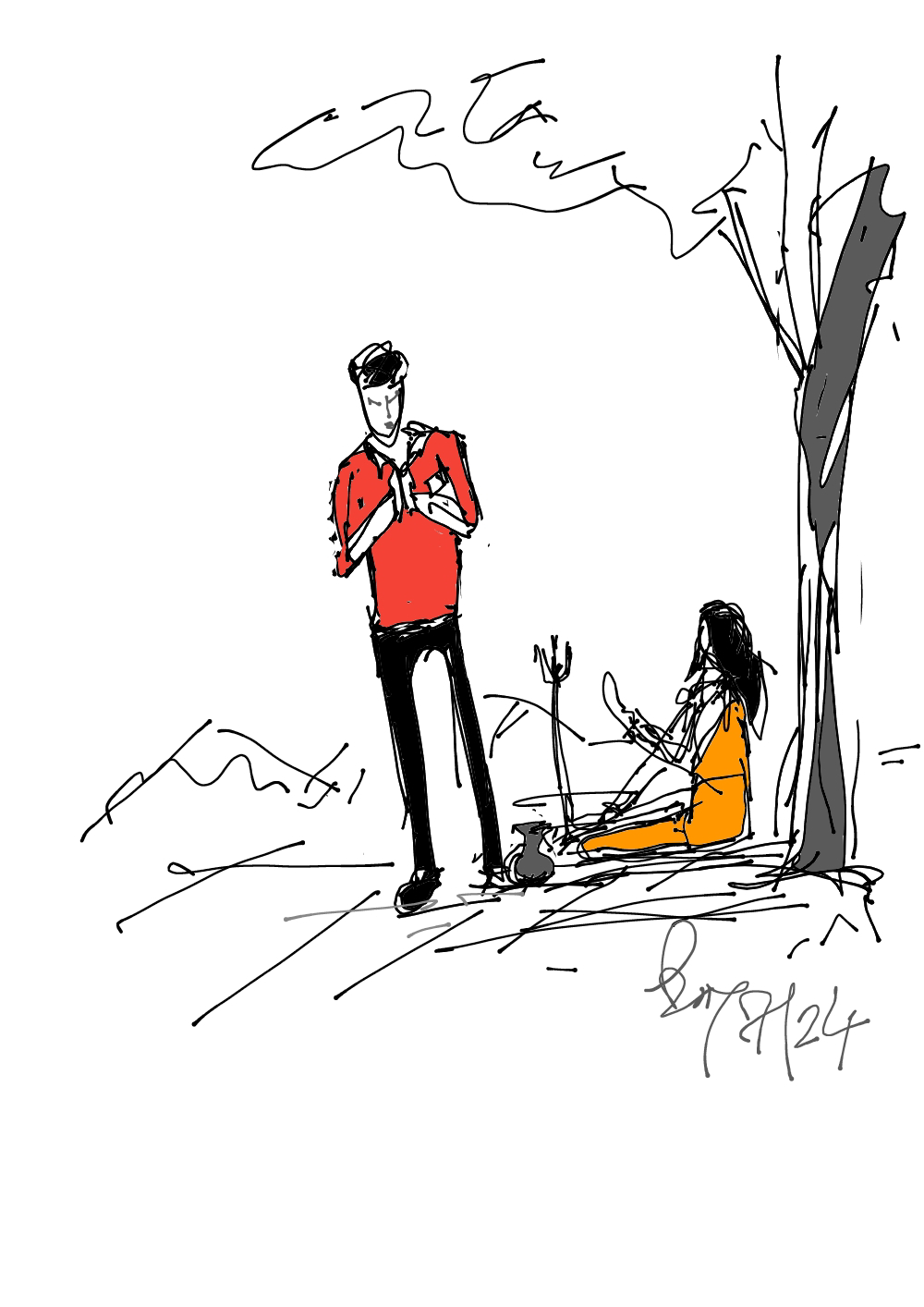
Subramanian had always been a curious man, and his curiosity often led him to the strangest of places. One day, he found himself climbing the hills beyond Rishikesh, seeking out sadhus who were known for their mystical powers. The hillside was dotted with holy men sitting under trees, each deep in meditation, looking like spiritual vendors displaying their wares to attract disciples.

Subramanian, however, wasn't interested in these regular sadhus. He had a very specific purpose in mind: he wanted to learn the art of bilocation—the ability to be in two places at once. This, he believed, would solve his most pressing problem back in Tamil Nadu: managing his two wives. He had read somewhere that Western saints could perform this trick, and he was determined to learn it.

As he ventured deeper into the jungle, the usual sadhus faded away, replaced by the sounds of nature. Finally, after hours of trekking, he stumbled upon a small clearing where an old sadhu sat cross-legged, his eyes closed, surrounded by an aura of tranquility.

"This must be the one," Subramanian thought, approaching with a mix of reverence and desperation.

The sadhu opened one eye, seemingly aware of Subramanian's presence. "What brings you here, my son?" he asked in a calm, deep voice.

"Great Sadhu, I seek the knowledge of bilocation," Subramanian replied earnestly. "I need it to manage my... complex domestic life."

The sadhu raised an eyebrow. "Bilocation? And why would you need such a skill?"

Subramanian explained his predicament: how he had ended up with two wives, each blissfully unaware of the other's existence, and how maintaining this delicate balance was becoming increasingly difficult.

The sadhu chuckled. "Ah, the things we men do for peace. Very well, I will teach you, but you must follow my instructions to the letter."

For the next few weeks, Subramanian trained under the sadhu's guidance. The exercises were bizarre: he had to meditate while balancing a coconut on his head, chant mantras while hopping on one foot, and even practice juggling with fire sticks. Despite the oddity of the tasks, Subramanian persevered, convinced that he was on the verge of mastering bilocation.

One day, the sadhu declared that Subramanian was ready. "Tonight, you will attempt bilocation," he said. "Find a quiet place, meditate deeply, and you will be in two places at once."

That night, Subramanian did as instructed. He found a secluded spot, sat down, and began his meditation. He felt a strange sensation, as if he was being stretched, and then—snap! He opened his eyes and found himself sitting in two places: one still in the jungle, and the other... in his home in Tamil Nadu, right between his two wives!

At first, Subramanian was thrilled. "It worked!" he thought. But his joy was short-lived. Both wives, startled by his sudden appearance, began questioning him simultaneously. He realized he could hear them both clearly, and worse, he had to answer both at the same time.

"Where have you been?" one asked.

"Why do you look so strange?" the other demanded.

As Subramanian tried to respond, he found that his words were jumbled, answering one wife's question with the other wife's answer. It was a comedy of errors. The more he tried to explain, the more entangled his lies became.

Finally, in a fit of panic, he tried to undo the bilocation, but he couldn't remember how. The sadhu hadn't taught him the return technique!

Back in the jungle, the sadhu was watching through his mystical powers and chuckling to himself. "Ah, the lessons we learn the hard way," he mused.

Subramanian spent the next few hours running between rooms, trying to keep up with both wives, who were now more suspicious than ever. Exhausted and desperate, he finally collapsed, wishing he had never sought out bilocation in the first place.

The next morning, Subramanian returned to the jungle, his face a mixture of fatigue and resignation. "Great Sadhu, I need your help. This bilocation is more trouble than it's worth."

The sadhu laughed heartily. "The secret to peace, my son, is not being in two places at once but being present where you are needed the most. Now, let me teach you the art of graceful escape."

And so, Subramanian learned the most valuable lesson of all: sometimes, the best magic is simply learning how to manage the chaos of life with a sense of humor and a lot of patience.


Saturday, July 20, 2024

Climbing the Stairway to Heaven: Journeying to Inner Peace and the Mystical Realms of the Mind

When I met Joshi, he was a changed man. The spark in his eyes was different, calmer, as if he had found an inner peace that eluded many of us. He shared his journey with me, a path that led him back to his roots in Uttarakhand. There, he met a sadhu who transformed his life. Intrigued, I pressed for details. "What did he do, or rather, what did you ask?" I inquired, eager to uncover the secret. Joshi smiled, a serene expression softening his features. "I wanted peace and control over my forgetfulness," he began. "So, what did the sadhu do?" I prodded gently. "He taught me self-hypnotism," Joshi replied. "I spent a month in his ashram, and it was no easy feat. To master self-hypnotism, I had to practice diligently. Creating a void in the mind is a real challenge when thoughts are racing incessantly. He advised me to lie down in a secluded place, close my eyes, and focus my mind on one subject to evacuate the clutter. I chose to imagine climbing a stairway to heaven." As he recounted his experience, I could almost picture Joshi lying under the canopy of ancient trees, the rustle of leaves and the distant hum of the Ganges serving as the backdrop to his mental journey. Each day, he would retreat to a secluded spot within the ashram, a place where the world seemed to pause. With eyes closed, he would take deep, measured breaths, feeling the cool earth beneath him and the warmth of the sun above. The sadhu's teachings were simple yet profound. "Imagine an endless stairway," he had instructed Joshi. "A stairway that ascends to the heavens. Focus on each step, feel the texture under your feet, the weight of your body shifting as you climb. Let everything else fade away." At first, Joshi's mind was a storm of thoughts, a chaotic dance of past memories, future anxieties, and present distractions. But with each session, he grew more adept at silencing the noise. The imaginary stairway became his anchor, each step a journey deeper into his own consciousness. Weeks passed, and Joshi's determination bore fruit. One day, as he climbed his mental stairway, he felt a profound stillness. The incessant chatter in his mind dulled to a whisper and then ceased altogether. He had reached the void the sadhu spoke of – a place of pure potential, where the mind could rest and rejuvenate. "I got hypnotized," Joshi continued, his voice barely above a whisper. "In that state, I found an incredible sense of calm. I could dig out information from my memory, details that were otherwise lost in the chaos. It even allowed me to embark on imaginary journeys based on books I was reading." He paused, his eyes twinkling with excitement. "One of the most extraordinary experiences was when I read 'Lost Horizon' by James Hilton. I was so captivated by the idea of Shangri-La that I decided to use it as my focus during self-hypnosis. In my mind, I traveled to that mystical valley, met the monks, and experienced the tranquility and wisdom of Shangri-La as if I were truly there." His vivid description transported me to that serene, fictional paradise. Joshi spoke of walking through the lush, verdant valleys, engaging in deep conversations with the wise monks, and feeling the profound peace of Shangri-La envelop him. The practice not only helped him manage stress but also opened new worlds of imagination and memory retrieval, enriching his life in ways he had never thought possible. His transformation was nothing short of miraculous, a testament to the power of the mind and the ancient wisdom of the sadhu. As I listened to Joshi, I couldn't help but feel a spark of curiosity and hope. If he could find such profound change, perhaps I could too. Inspired, I decided to give it a try, to seek out my own stairway to heaven and explore the depths of my consciousness. Thus began my journey, guided by Joshi's story, towards inner peace and mastery over my mind. The path was daunting, but with each step, I grew more confident, more attuned to the silent strength within. And in that silence, I discovered a world of possibilities, waiting to be explored.