Showing posts with label Arjun. Show all posts

Friday, January 24, 2025

"From Deceit to Dharma: Lessons on Righteousness and Karma from the Mahabharata"


The ancient Indian epic, Mahabharata, is a treasure trove of stories about valor, deceit, and the ultimate triumph of righteousness. Among the most compelling narratives is the tale of the Pandavas and Kauravas, cousins embroiled in a bitter struggle for supremacy that shaped the destiny of ancient India.

From a young age, the Pandavas—Yudhishthira, Bhima, Arjuna, Nakula, and Sahadeva—exhibited exceptional abilities, excelling in every field they undertook. This natural superiority bred envy and resentment among the Kauravas, particularly in their leader, Duryodhana. This envy soon turned into malice, culminating in schemes to eliminate the Pandavas through deceit and violence.

One of the most devious plots devised by Duryodhana was the construction of the house of lac, a flammable mansion intended to serve as a death trap for the Pandavas.

The Plot Unfolds

In the royal court of Hastinapura, Duryodhana presented his sinister idea to his father, King Dhritarashtra. “Father,” Duryodhana began, feigning concern, “our cousins, the Pandavas, deserve a vacation after their strenuous duties. I propose we send them to a magnificent palace I’ve had constructed in Varnavata. It is a marvel of architecture, built entirely from lac and other precious materials. They will surely be pleased.”

Dhritarashtra, blind both physically and metaphorically, sensed the unusual eagerness in his son’s voice. “But why such urgency, my son? What is it that you truly seek?” he asked hesitantly.

Duryodhana smiled, his tone measured but insidious. “Father, their stay will strengthen the unity of our family. It is merely a gesture of goodwill.”

Though Dhritarashtra harbored doubts, his love for Duryodhana outweighed his better judgment. He gave his reluctant consent, a decision that would haunt him later. Meanwhile, Vidura, the wise uncle of the Pandavas, who was ever watchful, overheard snippets of Duryodhana’s conversation with his confidants. His sharp intellect pieced together the devious plan.

Vidura’s Warning

Later that evening, Vidura sought a private audience with Yudhishthira. In his cryptic manner, he conveyed the danger that lay ahead. “Dear Yudhishthira,” Vidura said, “a clever man builds a bridge before the flood comes. When one walks through a jungle, it is wise to look for hidden snakes.”

Yudhishthira, perceptive as ever, understood Vidura’s coded message. “Uncle, do you mean to say that our journey to Varnavata harbors danger?” he asked cautiously.

Vidura nodded solemnly. “Indeed, my child. The house you are to stay in is not what it seems. It is made of lac, a substance as treacherous as it is beautiful. Duryodhana’s intentions are far from noble.”

Determined to protect his family, Yudhishthira heeded Vidura’s advice. The Pandavas secretly prepared for their escape, digging a tunnel beneath the house with the help of a trusted carpenter sent by Vidura. On the fateful night when Duryodhana’s agents set the lac house ablaze, the Pandavas and their mother, Kunti, made their escape through the tunnel, leaving the Kauravas to believe their plot had succeeded.

Lessons from the Mahabharata

This episode serves as a poignant reminder of the law of karma. The Kauravas’ malicious actions, born of jealousy and greed, set the stage for their eventual downfall. Despite their numerous attempts to harm the Pandavas, the latter’s resilience, wisdom, and adherence to righteousness ultimately led them to triumph.

The story of the lac house offers profound insights into human nature. It highlights how envy and deceit can consume individuals, blinding them to the inevitable consequences of their actions. The Pandavas, on the other hand, exemplify the virtues of wisdom, patience, and the ability to rise above adversity.

The law of karma, a cornerstone of Hindu philosophy, teaches that every action—good or bad—has consequences. The Kauravas’ repeated schemes to harm the Pandavas only hastened their own destruction. The epic battle of Kurukshetra, which followed years later, saw the Pandavas emerge victorious, guided by their ally Krishna and their unwavering commitment to dharma (righteousness).

A Timeless Message

As we reflect on this ancient narrative, we find timeless lessons relevant to modern life. The story urges us to choose the path of righteousness, even in the face of adversity, and reminds us that actions motivated by malice and greed will eventually lead to ruin.

In today’s world, where competition and jealousy often cloud judgment, the wisdom of the Mahabharata encourages us to cultivate compassion, empathy, and integrity. By embodying these values, we can navigate life’s challenges with grace and leave a legacy of goodness and justice.

In the end, the tale of the Pandavas and Kauravas is not just a story of conflict; it is a profound lesson on the eternal balance of the universe and the enduring power of righteousness.

Thursday, January 02, 2025

A slice of Mahabharata as interpreted by me


The Mahabharata is a treasure trove of human emotions, dilemmas, and lessons. Among its myriad turning points, the dice game and the events surrounding Jayadratha's slaying stand out as moments that not only shaped the course of the epic but also revealed the vulnerabilities of even the noblest characters.

The Dice Game: A Noble Man’s Fall

Yudhishthira, the eldest of the Pandavas, was the epitome of dharma, yet he harbored a fatal flaw—his penchant for dice. Fueled by ego and the lure of proving himself in a game of chance, he fell into the trap cunningly laid by Duryodhana and his uncle Shakuni. The dice, loaded and manipulated by Shakuni, ensured Yudhishthira’s defeat at every turn.

As Yudhishthira gambled away not just his kingdom and wealth but also his brothers, himself, and ultimately Draupadi, the consequences of unchecked greed and ego became horrifyingly apparent. The humiliation of Draupadi in the Kaurava court, where vile figures like Dushasana attempted to disrobe her, remains one of the darkest moments in the epic. Draupadi’s honor was saved by divine intervention, but the damage to the Pandavas' dignity was irrevocable. This episode marked the "Good, Bad, Ugly" dynamic vividly: the noble Yudhishthira (Good), the cunning Shakuni and Duryodhana (Bad), and the grotesque Dushasana and his ilk (Ugly).

Jayadratha's Infamy

Jayadratha, the husband of Dushala, the only sister of the Kauravas, epitomized cowardice and malice. Lusting after Draupadi during the Pandavas’ exile, he seized an opportunity to abduct her while the brothers were away. However, his plan was foiled when Arjuna and Bhima tracked him down using Arjuna’s sound-detecting arrows. They humiliated him, shaving his head—a grave insult—but spared his life on Yudhishthira’s insistence. This act of mercy would later haunt the Pandavas, as Jayadratha nursed his grudge.

The Death of Abhimanyu

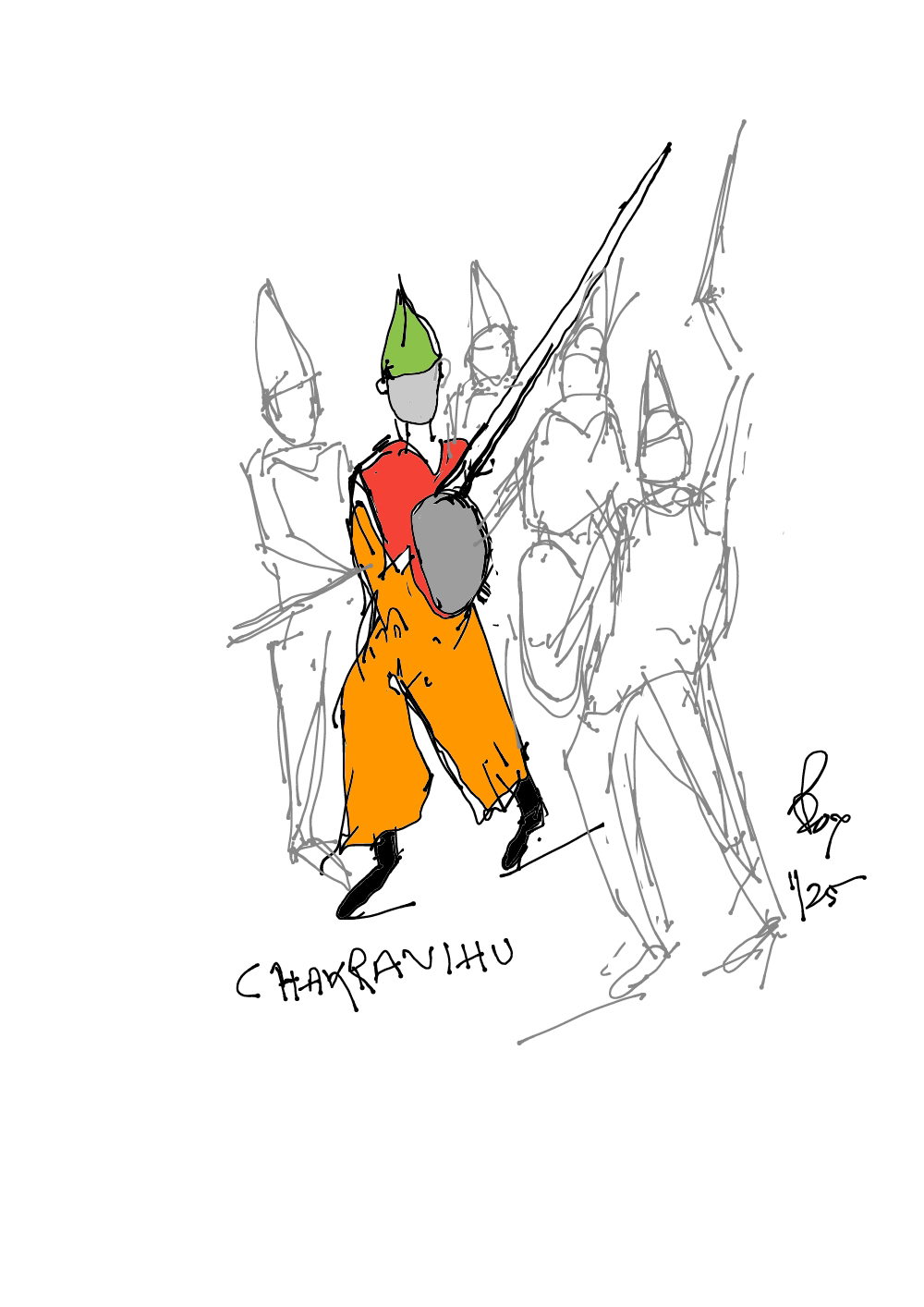
Jayadratha’s moment of revenge came during the Kurukshetra war. On the 13th day, Dronacharya devised the deadly Chakravyuha formation, a labyrinth of warriors that could only be penetrated by someone with expert knowledge. Abhimanyu, Arjuna’s young son, stepped forward, armed with partial knowledge of the formation. He broke into the Chakravyuha but was unable to exit.

Jayadratha played a key role in keeping the Pandavas, especially Arjuna, at bay, ensuring that no one could rescue the valiant Abhimanyu. Inside the formation, Kaurava warriors broke the rules of dharma, attacking the lone Abhimanyu from all sides and stabbing him from behind. The young warrior fought with unmatched valor, but his death left the Pandavas devastated.

Arjuna’s Oath

When Arjuna learned of Abhimanyu’s brutal death, he was overcome with grief and rage. He vowed to kill Jayadratha before sunset on the 14th day of battle. If he failed, he promised to immolate himself, a declaration that raised the stakes for both sides.

Jayadratha, aware of Arjuna’s prowess, spent the next day hiding behind the Kaurava forces, which formed a formidable shield around him. As the day wore on, the Kauravas grew hopeful, while the Pandavas worried about Arjuna’s vow.

The Illusion and the Slaying

As the sun neared the horizon, Jayadratha, believing the day was won, emerged from hiding to mock Arjuna. The Kauravas celebrated prematurely, thinking Arjuna had failed. But Krishna, the divine charioteer and strategist, had one last move. Using his Sudarshan Chakra, Krishna created an illusion of sunset, plunging the battlefield into apparent twilight.

As Jayadratha taunted Arjuna, the illusion lifted, revealing the sun still in the sky. Arjuna, with his unparalleled archery, fired a deadly arrow that severed Jayadratha’s head. Krishna had warned him to aim so that Jayadratha’s head would land in his father’s lap—a boon Jayadratha’s father had granted him, cursing anyone who caused his head to fall to the ground. Arjuna’s precision ensured this, causing Jayadratha’s father to inadvertently drop the head, dying instantly and fulfilling the curse.

Justice Delivered

Jayadratha’s death was not just a personal victory for Arjuna but a moral one for the Pandavas. It restored some sense of justice to the battlefield, avenging Abhimanyu’s untimely death and reinforcing the idea that dharma, though often delayed, ultimately prevails.

Reflections on Greed, Ego, and Retribution

The dice game and the events surrounding Jayadratha’s death underscore timeless lessons. Just as Yudhishthira’s ego led to devastating consequences, Jayadratha’s cowardice and malice brought about his downfall. These stories serve as reminders of human frailty, the perils of unchecked ambition, and the inevitability of karmic justice.

In the Mahabharata, even the noblest characters faltered, but it is through their struggles, mistakes, and redemption that the epic teaches us about the complexities of life and morality.

Friday, December 13, 2024

The iron embrace, a tale from Mahabharat

The Iron Embrace: A Tale of Wisdom and Preparedness


The war of Kurukshetra had ended, leaving the battlefield drenched in sorrow and blood. The Pandavas, victors of the conflict, now bore the burden of reconciliation. It was time to pay their respects to the grieving king, Dhritarashtra, who had lost all his sons, including his beloved Duryodhana. But Krishna, ever the foresighted, sensed a storm brewing in the king’s heart.

One evening, Krishna gathered the Pandavas and shared his insight. “Dhritarashtra’s grief is vast, but so is his fury. Bhima, his rage against you for killing his sons, especially Dushasana and Duryodhana, burns fiercely. Beware, for his intent to embrace you might hide a fatal trap.”

The Pandavas were stunned. Arjuna exclaimed, “But he is our uncle, our elder! How can we deny him this gesture of respect?”

Krishna smiled. “We won’t deny him, Arjuna. But we shall outwit him. Prepare for the worst, and no harm will befall you.”

Krishna sought out a trusted blacksmith in the kingdom, a man named Surath, renowned for his craftsmanship and discretion. Surath listened as Krishna explained the plan: an iron replica of Bhima was to be created, perfect in form and weight, to withstand Dhritarashtra’s crushing embrace.

The Crafting of Bhima

Surath took on the task with solemnity. He began by crafting a clay mold of Bhima, ensuring every muscle and contour matched the mighty warrior. To create the mold, Bhima stood as the model while molten wax was poured to form a core. Over days, Surath carefully layered the mold with iron, heating and hammering until it solidified into a lifelike form.

Krishna supervised the process, offering Surath both guidance and humor. “Remember, Surath, the arms must be strong enough to withstand the grief of a father and the strength of a warrior. A moment’s failure here could cost a life.”

When the replica was complete, it stood as an imposing figure—Bhima’s doppelgänger in every detail. Krishna inspected it and declared, “Perfect! This will serve as the shield we need.”

The Day of the Embrace

The Pandavas approached Dhritarashtra with reverence, touching his feet one by one. When it was Bhima’s turn, Krishna subtly signaled the servants to wheel in the iron statue, hidden behind a curtain.

As Bhima bent to touch Dhritarashtra’s feet, Krishna whispered, “Stay low, Bhima, and move aside.” With a sleight of hand befitting a conjurer, Krishna and his men replaced Bhima with the iron replica in a blink.

Dhritarashtra, overwhelmed with emotion, pulled the replica into a crushing embrace. The iron figure groaned under the pressure, and with a final, earth-shaking squeeze, Dhritarashtra reduced it to rubble.

The king staggered back, realizing the truth. “What have I done?” he cried. “Was it Bhima?”

Krishna stepped forward, calm as ever. “No, Maharaj. It was not Bhima, but a symbol of your grief and fury. You sought to avenge your sons, but revenge brings no solace. Bhima lives, and your act of anger has passed without tragedy.”

A Lesson in Preparation

Later that evening, Krishna gathered the Pandavas. “This day teaches us an eternal truth: always prepare for the worst, even when meeting an elder or friend. Dhritarashtra’s sorrow blinded him to wisdom, but our foresight saved a life.”

Bhima turned to Surath and clasped his hands. “Your craftsmanship has not only saved me but also preserved our uncle’s dignity. The world needs men like you, who mold solutions as surely as they mold iron.”

Surath bowed humbly. “It was your wisdom, Krishna, that guided my hammer.”

Krishna concluded with a smile. “Victory in war is one thing, but survival in peace demands foresight, wit, and unity. Let this day remind us of the value of preparation and trust in one another.”

The Pandavas carried this lesson forward, their bond strengthened, and their trust in Krishna’s wisdom unshakable.

Wednesday, May 10, 2017

A little push

A little push
……………………
“Sir, someone wants to meet you.”
I was in my chamber in Chatterjee International when my PA Late S N Bose came in.
“Who?” I asked.
Bose ushered in a middle aged gentleman dressed nattily.
“Sir, I am Arjun.” That gentleman said and then he became emotional, with tears in his eyes touched my feet. He broke down and said, “I have been looking for you for a long time.”
I could not believe my eyes, Arjun whom I knew was a strapling young man.
I still remember vividly the first day when I met Arjun in the canteen of Barauni Refinery.
Me,Bhatia and Verma like every day were there in the canteen for our morning tea when I noticed a young man hardly of 17/18 yrs or so of age in shorts was busy serving the clients. He was very actively running between the tables. I asked Nazareth, the manager of the canteen about that young man. He informed me that he had come recently from Bengal with an oil tanker driver.
Next day I called that young man to find more about him. After talking to him I came to know his name and how he had chanced upon a Sardarji oil tanker driver at Haldia and came away looking for a job opportunity. Thus Arjun landed in the canteen of Barauni Refinery.
This was sometimes in late 1975 when construction of Indian Oil’s Haldia refinery was in full swing. My father in law was Chief Engineer in Haldia Refinery then and my son was just born. I used to visit Haldia frequently those days as my wife was with her parents there.
I was surprised that inspite of a massive construction work going on next door Arjun had to leave the state as he could not land a job there. I took a pity on him and told him, “Next time when I go to Haldia I will take you with me and try to fix a job for you.”
He readily agreed.
I paid him for his train fare from Barauni to Calcutta plus bus fare up to Haldia and gave him my father in laws' address.
As planned I reached Haldia and Arjun came and met me. His village was hardly 20kms away. Munshida who was Deputy Manager Civil in Haldia Refinery was very close to me. I requested him to fix up Arjun with some labor contractor and he did so. Arjun started working as a laborer in the civil construction, would often visit my father in law’s bungalow to meet me. He used to bring wooden village toys for my son.Ín front of the bungalow he planted a palm tree which he brought from his village. The time passed on I resigned from IOC in 1978 and lost touch with Arjun.
That day in 1996 that was after 21 years he was standing in front of me narrating his progress in life.
From a daily labor he became a labor supplier. From there he became a civil contractor. He got married and seen to it that his younger brothers got good education. His one younger brother joined refinery as operator. He constructed a double storied house in place of that thatched roof hut which I visited during my stay in Haldia, he was owning a car and a motor bike. Later on my attendant Subhash who stays near Arjun’s village told me that he was politically strong too.
I was impressed by his progress in life, his hard work and entrepreneurship took him to a different level. I was just an enabler; rest was his hard work and determination.
I had a chance to visit Haldia Refinery in connection with BHEL work in 1998, the bungalow where my father in law was staying is very close to the IOC,Guest House. In the evening I walked down to the bungalow and found that the palm tree planted by Arjun has grown tall symbolizing Arjun’s progress. All the memories connected with that bungalow started flooding in my mind, in the moonlight I could see the Haldi River behind the bungalow flowing quietly towards the sea reminding the flow of time.
Many young men in India like Arjun are waiting for just a break and then there is no looking back for them. Also there are those who are born in privileged family and got all right breaks but could not achieve much. Recently in the company with which I am associated now there were interviews for the recruitment of fresh engineers. All the candidates were from private engineering colleges and must be from fairly well to do families. Some of them had come with their mothers. The senior officers who took their interview informed me that they could not find a single one up to the mark so did not select any.Possibly some  of these rejected candidates may take up some other profession and shine, we know many of these are forced to do engineering by their ambitious parents whereas their calling may lie somewhere else.


Thursday, April 14, 2016

Keechak Vadh...retold

Keechak  Vadh...retold
………………..

Please don’t force me, I am already married to Gandarvas, they are five in number and mostly remain invisible. Pleaded Sairandhari to Keechak the Chief of Army of Virat Raj of Matsaya kingdom. Keechak was also brother in law of the king.
But the ruffian Keechak won’t leave Sairandhari who actually is Draupadi. During this time of Pandava’s exile the last year was Agyat Vas , they have to live in anonymity. Draupadi as Sairandhari was working as maid of the queen and Keechak was enthralled by her beauty and wanted to marry her.
Let us see how her five husbands were hiding their identity. Incidentally all six of them decided to spend the one year of anonymity in Matsaya kingdom which was very close to Hastinapur, the plan was audacious as Duryadhan had put spies to locate them, as per condition if Pandavas are spotted then their exile will start from the beginning which was 12 years of exile in forest and one year of Agyat Vas. All of them did not arrive together; Yudhishthir came as a Brahmin who was expert in playing dice. The king appointed him as a minister and would play dice often with him. Yudhishthir was addicted to playing dice and having lost kingdom in a crooked dice game with Duryadhan he was honing his skill in playing dice with the king of Virat. Another dice game with Duryadhan? I don’t think he would have played having lost everything. Of course there was no scope for that as Kurushetra battle was the deciding field or the killing field for Kauravas, Where Arjun’s Gandiv spoke, Bheem’s gada thundered and Krishna’s far sight steered them to brutal victory….धर्मक्षेत्रे कुरुक्षेत्रे समवेता युयुत्सवः।
मामकाः पाण्डवाश्चैव किमकुर्वत संजय॥१-१॥
Sanjay, gathered in Dharma-kshetra Kurukshetra (place of Dharma, Kurukshetra), what are my and Pandava’s sons doing?
That was blind Dhritrashtra asking Sanjay about the battle………..those are the opening sentences in Bhagwat Gita.
Well let me roll back to Virat where Keechak is making his advances to Draupadi. It is a tricky situation for Pandavas, if they interfere then they will stand exposed and Duryodhan’s spies will pick up the scent. Their incognito stay will be exposed. Yudhishthir as usual advises Panchali or Draupadi or Sairandhari to manage the situation. Arjuna had a curse to be a eunuch, he is disguised as Brihanalla and engaged to teach dance to the princess Uttara. So he is of no use to handle the explosive situation. Draupadi is smarting under the lewd remark thrown at her by Keechak. She wants Keechak’s blood. Nakul is Royal groom in horse stable and Shadev is a royal cowherd, but as we know both are not warriors to match Keechak who is a great fighter.
Let us come to the fateful day.
As usual Draupadi after finishing her chore was coming out of queen’s chamber when the willy Keechak who was lurking around jumped on her. She struggled tooth and nail, fell on the ground , got hurt, her head starting bleeding , seeing the blood Keechak left her for the time being promising to be back. Draupadi goes running to king’s court and pleads with the king. The king is helpless , Yudhishthir as Kanka who was present there in the court asked her to manage the crisis. Draupadi was in rage and wanted revenge and swore not to wipe her blood till Keechak is killed by the night.
Oh, I forgot to mention about Bheem. Bheem was fond of food so he disguised himself as cook named Ballav. Ballav had heard about humiliation of Sairandhir or Draupadi in the hand of Keechak so he rushes to court to help Draupadi. Kanka means Yudhishthir stops him saying that his rash action will expose them to Durayadhan and their terms of 12 years of Vanbas and 1 year of Agyatbas will start again as per conditions.
But Draupadi has already taken oath of revenge; she meets Bheem in kitchen and asks him to act. So the scene is like this..Yudhishthir will not act, Arjuna is eunuch as Brihanalla so can’t act, Nakul and Sahdev are no match so it was left to Bheem.
Draupadi and Bheem hatch a plan.
Keechak is very excited finally his wish of spending night with Sairandhari or Draupadi will be full filled tonight.He takes a few goblets of Madira to ginger himself up for the big occasion. He stealthily approaches the dance hall where Draupadi is waiting for him.
He reaches the dance hall , a very few lamps on the wall was lighted. The reflected light of outside moon on those glass works around created a mesmeric ambience. In that mystic atmosphere Keechak spotted Draupadi waiting for him in a corner. She was draped head to toe in a black cloth. The creep Keechak with his libido approaches her and touches her shoulder lovingly.
“Wham”  a big fist lands on his face, from the cover of black cloth Bheem reveals himself. We don’t have to dwell much on the fight as we all know Bheem is way above the inebriated Keechak. He just kills him within a few moments; hardly that Chief of army of Virat could put up a fight.
Somehow this Virat parba of Mahbharat always intrigued me. Arjuna famous with his Gandiv was helpless as he was cursed to be eunuch. Why was he eunuch?
Here is why?
When Arjuna, the hero of Mahabharata, visited Amaravati – the Palace of Indra to obtain the weapon from his father( by the way Indra was the biological father of Arjuna), a party was arranged for his reception where court dancers of celestial beauties and fame like Urvashi, Tilottama, Rambha and Menaka were invited to perform. During the programme, there was exchange of passionate glances between Arjuna and Urvashi and in the night when Urvashi stealthily came to Arjuna’s bedroom with an intention to present herself to him, Arjuna retracted addressing her as mother.
Dear Arjun it is not done, calling an apsara Amma, it is like Arjun Kapoor in the film Gundey calling the cabaret dancer Priyanka Chopra a mother.
Urvashi felt very much insulted and being extremely annoyed, she cursed Arjuna that he would become eunuch and live with women dancing and singing. Later, on the request of Indra, Urvashi reduced the curse from whole life to only one year period i.e. the thirteenth year of Pandavas’ exile.
So Arjun as Brihnalla is a eunuch in reality because of the curse of Urvashi. 
Yudhishthir as usual gave gyan like a consultant does in any company but of course he had the responsibility of keeping anonymity. He was right on his own way.
But then we have this hot headed Bheem, Draupadi had to finally use her charm on him to act and the act he did with real gusto. Imagine the plight of Keechak who lustily approaches the shadowy figure draped in black for a good time and gets the shock of his life. He was there for amorous purpose and not for wrestling duel. I would have loved to watch his expression. 

 Yes that is the climax which I liked, i tried telling that episode the way i looked at it. Kind of retold by me.